Enjoy the story.
Begin with the characters and the adventure. New science words are easier to approach when there’s a story to return to.
The parent’s guide
A science story can be the start of something bigger: a question, a connection, a new way of looking at the world.
Find the descriptions, science explanations, and reading ideas behind each Dr. Quazoo book. Follow your child’s curiosity, one conversation at a time.
Explore the book-by-book guideScience & STEM at storytime
The stories introduce science ideas.
Your conversations help bring them into everyday life.
Begin with the characters and the adventure. New science words are easier to approach when there’s a story to return to.
Ask what your child notices. Invite a guess, a question, or a drawing. You do not have to explain every detail at once.
Look for the idea in water, a leaf, the air, or the night sky. Build the habit of observing, comparing, and asking for reasons.
Inside the Molecule Series
Book descriptions, background science,
and ideas for exploring beyond the pages.
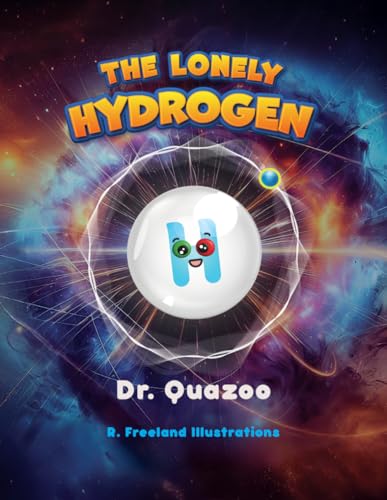
Book 01 · Atoms & the universe
Start with the smallest element and open a conversation about the biggest questions. This illustrated science story gives families a way into atoms, the universe, and the idea that the world around us is made of tiny building blocks.
Hydrogen is the most abundant element in the universe. Every hydrogen atom has one proton. Hydrogen is found in stars and in everyday substances: each water molecule contains two hydrogen atoms bonded to one oxygen atom.
If atoms are too small to see, how can they be part of something as big as a star?
Read for the adventure first. On a second reading, pause at an unfamiliar word and connect it to something your child already knows: a glass of water, the Sun, or a starry sky.
Draw two circles marked H and one marked O. Join each H to the O with a line. Count the atoms together and introduce the name H₂O. Explain that this is a simple model, not a picture of what a molecule actually looks like.
Keep the model clear: The character’s feelings help tell the story. Real atoms do not feel lonely or decide to make friends; bonding is a physical process.
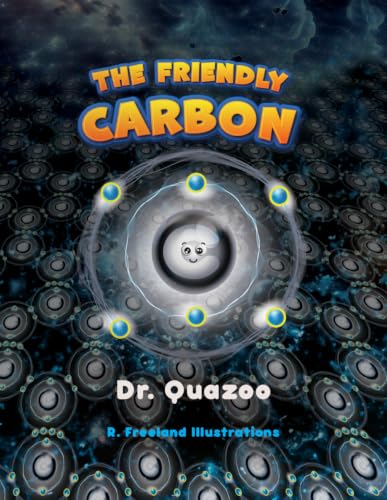
Book 02 · Connections & the chemistry of life
Carbon offers a natural starting point for talking about connections. Use the story to introduce chemical bonds, then look beyond the pages to plants, food, and the many different materials that contain carbon.
A carbon atom has six protons. Carbon can form four covalent bonds and is part of the molecules that make up living things. Diamond and graphite are both forms of carbon, but their atoms are arranged differently, giving them very different properties.
How can the same element be part of a pencil and a diamond?
A leaf, a piece of fruit, and a pencil offer starting points for a conversation about carbon. Let your child describe what they notice before introducing new science words.
Draw a C with four lines extending from it. Use it as a starting point to talk about carbon’s ability to form bonds. Then compare a pencil mark with a picture of a diamond. Ask how a different arrangement could change a material.
Keep the model clear: “Friendly” is a story metaphor. Carbon does not choose its partners. How atoms bond depends on their electrons and the conditions around them.
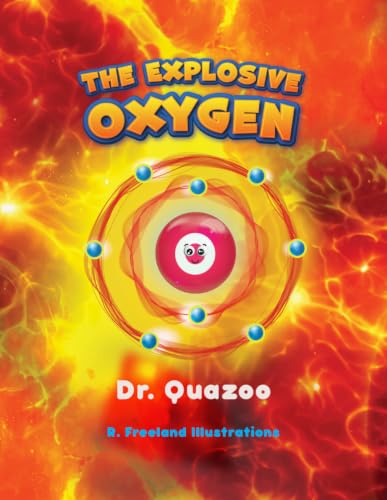
Book 03 · Air, energy & reactions
Oxygen opens up conversations about air, water, breathing, and chemical reactions. After the adventure, help your child connect the element’s name with things they encounter every day, while keeping the science behind the dramatic title clear.
An oxygen atom has eight protons. Oxygen gas in the air is mostly O₂: two oxygen atoms bonded together. Oxygen supports combustion, but is not itself a fuel. It is also part of water and is used by our bodies in processes that release energy from food.
If oxygen is in both air and water, why are air and water so different?
Return to the water model from Hydrogen. Changing the combination of atoms is a useful way to introduce the idea that molecules have their own properties.
On paper, draw two circles marked O and connect them. Next, draw one O connected to two H circles. Count the atoms in each model. Talk about how different combinations of atoms make different substances.
Keep the model clear: The title is dramatic; the distinction matters. Oxygen helps other substances burn. It is not itself flammable. Use drawings and conversation for this reading activity.
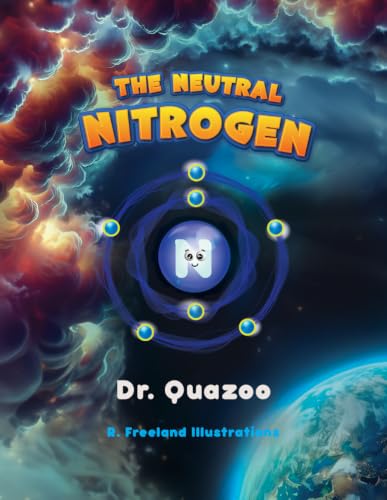
Book 04 · Our atmosphere & living things
Close the four-book collection with an element that is all around us. Nitrogen provides a starting point for exploring the atmosphere and the connections between air, plants, and living things.
A nitrogen atom has seven protons. Nitrogen gas makes up about 78% of Earth’s atmosphere. It usually occurs as N₂, with two nitrogen atoms joined by a strong triple bond. Nitrogen is also a component of proteins and DNA.
Can something be important even when we cannot see it?
Revisit Hydrogen, Carbon, and Oxygen. Ask your child to name one thing they now wonder about each element. Curiosity is a better finish line than a quiz score.
Draw a grid of 100 squares. Colour 78 for nitrogen, 21 for oxygen, and one for other gases. This is an approximate model of dry air. Ask which gas there is most of, and what the model leaves out.
Keep the model clear: An electrically neutral atom has equal numbers of protons and electrons. That is different from saying a substance never reacts: nitrogen can form many compounds.
A helpful distinction
Atoms do not have feelings or intentions. The characters make the stories imaginative; real atoms and molecules follow physical and chemical processes.
Help your child move between the story and the science. Ask, “Which part helps us imagine the idea? Which part tells us something about the real world?” The reading activities here are simple models and conversation prompts, offered as extra guidance alongside the books.
For deeper background, the book guides link to the Royal Society of Chemistry’s periodic table. These are independent reference resources.
Good questions from grown-ups
Begin with The Lonely Hydrogen, then follow Carbon, Oxygen, and Nitrogen. You can also choose the element that most interests your child. Each book has its own page with a description and ideas for exploring together.
No. Read the story together, ask what your child notices, and explore one idea at a time. Our parent’s guide explains the science in plain language and links to the Royal Society of Chemistry for deeper reading.
Choose according to your child’s interest in the subject and comfort with new vocabulary. Shared reading lets you pause, explain a word, or follow a question. Check the current retailer listing for edition-specific reading-age information and any available preview.
The Molecule Series consists of illustrated science stories. Use them to introduce ideas and start conversations alongside your child’s learning at home or school. The website’s reading prompts and activities are supplementary suggestions for families.
Each book links to its Amazon.ca listing. The retailer provides current pricing, editions, delivery information, and availability. Readers elsewhere can also visit Dr. Quazoo’s Amazon author page.
Both series are coming soon. Release dates, book titles, and cover artwork have not yet been announced on this site. Visit Our series for the latest published details.