Ask a big question
“If oxygen is in both air and water, why are air and water so different?”
Let your child share an idea before you offer an explanation. It’s fine to say, “Let’s find out together.”
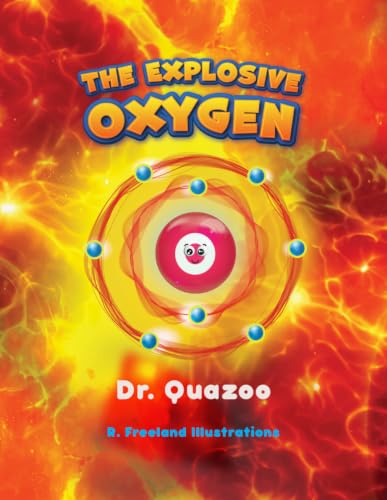 Cover illustration by Rose Freeland
The Molecule Series · Book 03
By Dr. Quazoo · Illustrated by Rose Freeland
The third space adventure in the Molecule Series puts oxygen in the spotlight. Discover a familiar element through an illustrated story that invites questions about science.
Current editions, pricing, and availability are provided by the retailer.
Why share this book?
Oxygen opens up conversations about air, water, breathing, and chemical reactions. After the adventure, help your child connect the element’s name with things they encounter every day, while keeping the science behind the dramatic title clear.
Return to the water model from Hydrogen. Changing the combination of atoms is a useful way to introduce the idea that molecules have their own properties.
Atomic number = the number
of protons in an atom
The science behind the story
An oxygen atom has eight protons. Oxygen gas in the air is mostly O₂: two oxygen atoms bonded together. Oxygen supports combustion, but is not itself a fuel. It is also part of water and is used by our bodies in processes that release energy from food.
The title is dramatic; the distinction matters. Oxygen helps other substances burn. It is not itself flammable. Use drawings and conversation for this reading activity.
Beyond the pages
Supplementary ideas for your family’s reading time.
Ask a big question
Let your child share an idea before you offer an explanation. It’s fine to say, “Let’s find out together.”
Try a simple activity
On paper, draw two circles marked O and connect them. Next, draw one O connected to two H circles. Count the atoms in each model. Talk about how different combinations of atoms make different substances.
Keep the discovery going
Atoms & the universe
Explore the book
Connections & the chemistry of life
Explore the book
Our atmosphere & living things
Explore the book