Ask a big question
“How can the same element be part of a pencil and a diamond?”
Let your child share an idea before you offer an explanation. It’s fine to say, “Let’s find out together.”
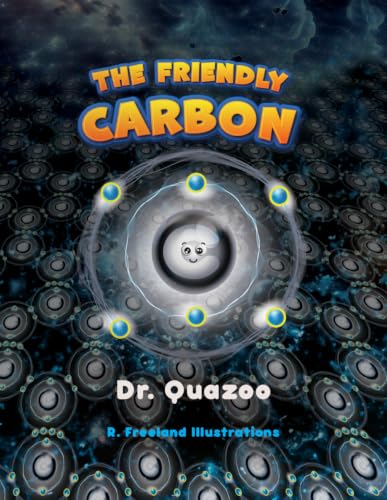 Cover illustration by Rose Freeland
The Molecule Series · Book 02
By Dr. Quazoo · Illustrated by Rose Freeland
Meet carbon in the second illustrated space adventure in the Molecule Series. A story-led invitation to explore an element at the heart of the chemistry of life.
Current editions, pricing, and availability are provided by the retailer.
Why share this book?
Carbon offers a natural starting point for talking about connections. Use the story to introduce chemical bonds, then look beyond the pages to plants, food, and the many different materials that contain carbon.
A leaf, a piece of fruit, and a pencil offer starting points for a conversation about carbon. Let your child describe what they notice before introducing new science words.
Atomic number = the number
of protons in an atom
The science behind the story
A carbon atom has six protons. Carbon can form four covalent bonds and is part of the molecules that make up living things. Diamond and graphite are both forms of carbon, but their atoms are arranged differently, giving them very different properties.
“Friendly” is a story metaphor. Carbon does not choose its partners. How atoms bond depends on their electrons and the conditions around them.
Beyond the pages
Supplementary ideas for your family’s reading time.
Ask a big question
Let your child share an idea before you offer an explanation. It’s fine to say, “Let’s find out together.”
Try a simple activity
Draw a C with four lines extending from it. Use it as a starting point to talk about carbon’s ability to form bonds. Then compare a pencil mark with a picture of a diamond. Ask how a different arrangement could change a material.
Keep the discovery going
Atoms & the universe
Explore the book
Air, energy & reactions
Explore the book
Our atmosphere & living things
Explore the book